The booking came in with no details. New venue, promoter you haven't worked with before, time slot somewhere in the middle of the night. When you asked about the crowd, they said "mixed" and "keep it moving." That's it.
You have two weeks to prep. And right now, you have no idea who's walking through that door.
The two bad responses to a blank brief
Most DJs default to one of two things when they don't know the crowd.
The first is packing everything. You pull together four hundred tracks, tell yourself you'll read the room, and trust that the answer to uncertainty is volume. The night comes, you open your library mid-set, and you spend thirty seconds scrolling through tracks you haven't listened to in months, looking for something that fits a moment you can't quite name while the last track runs out.
The second is planning too tightly. You build a single, sequenced playlist, lock it down, and convince yourself the crowd will follow. Sometimes they do. More often, the room is somewhere different to where you expected, and the playlist you built for one situation doesn't flex.
Both approaches avoid the actual problem. The problem is not how many tracks you carry. It's whether the tracks you carry cover the different directions the night might go.
Think in directions, not quantities
A set without a brief could go several ways. The crowd might arrive early and need warming slowly. It might arrive late and already be moving. The room might want to stay in a groove for two hours, or it might need to shift energy in the middle.
You cannot know in advance. But you can identify the three or four most likely directions and prepare for each.
Pick one anchor track for each direction. Not a folder, not a genre — one specific track that you know belongs in each moment. A track for a quiet, careful opener. A track for a mid-set point where things are moving but not at the ceiling. A track for if the room is warm and you need to push.
Each anchor is a starting point, not a plan. You are not committing to playing it. You are using it to pull candidates from your library that fit the feel you might need.
Building range from multiple anchors
This is where the prep work actually happens.
Start with your opening anchor. Ask: what else in my library belongs near this? Not tracks in the same genre folder. Tracks with similar energy, similar texture, similar feel — things that could follow this anchor without jarring anyone who arrived early and is still finding their footing.
Add a handful of those to a loose shortlist. Then move to your next anchor — the mid-set one. Same question. What belongs near this? Different neighbourhood, different feel, some overlap with the first cluster if the energy range is close, but its own set of candidates.
Do the same from the peak anchor.
What you end up with is a shortlist that has real coverage: tracks that work for a careful start, tracks that work for a building middle, tracks that work if the room gets there. Not five hundred tracks sorted by nothing. A deliberate pool, organised by what each section of the night might need.
What makes this different from just packing more
The volume approach gives you the illusion of flexibility. You have hundreds of tracks, so surely something will fit.
But a large pile of unorganised tracks is not the same as a set with range. Under pressure, mid-set, you will still reach for what you know. The unknown tracks in the pile will stay unknown. The flexibility you thought you had does not materialise when you need it.
The anchor approach gives you flexibility in a form you can actually use. When you arrive and read the room and realise this crowd is going to need a longer warm-up than expected, you know which part of your shortlist covers that. You are not searching. You are choosing from a cluster of candidates you already heard and approved, specifically for that moment.
That distinction — between options you can actually access and options that theoretically exist in the pile — is what determines how well you adapt.
What MusicMapper is useful for here — and where it stops
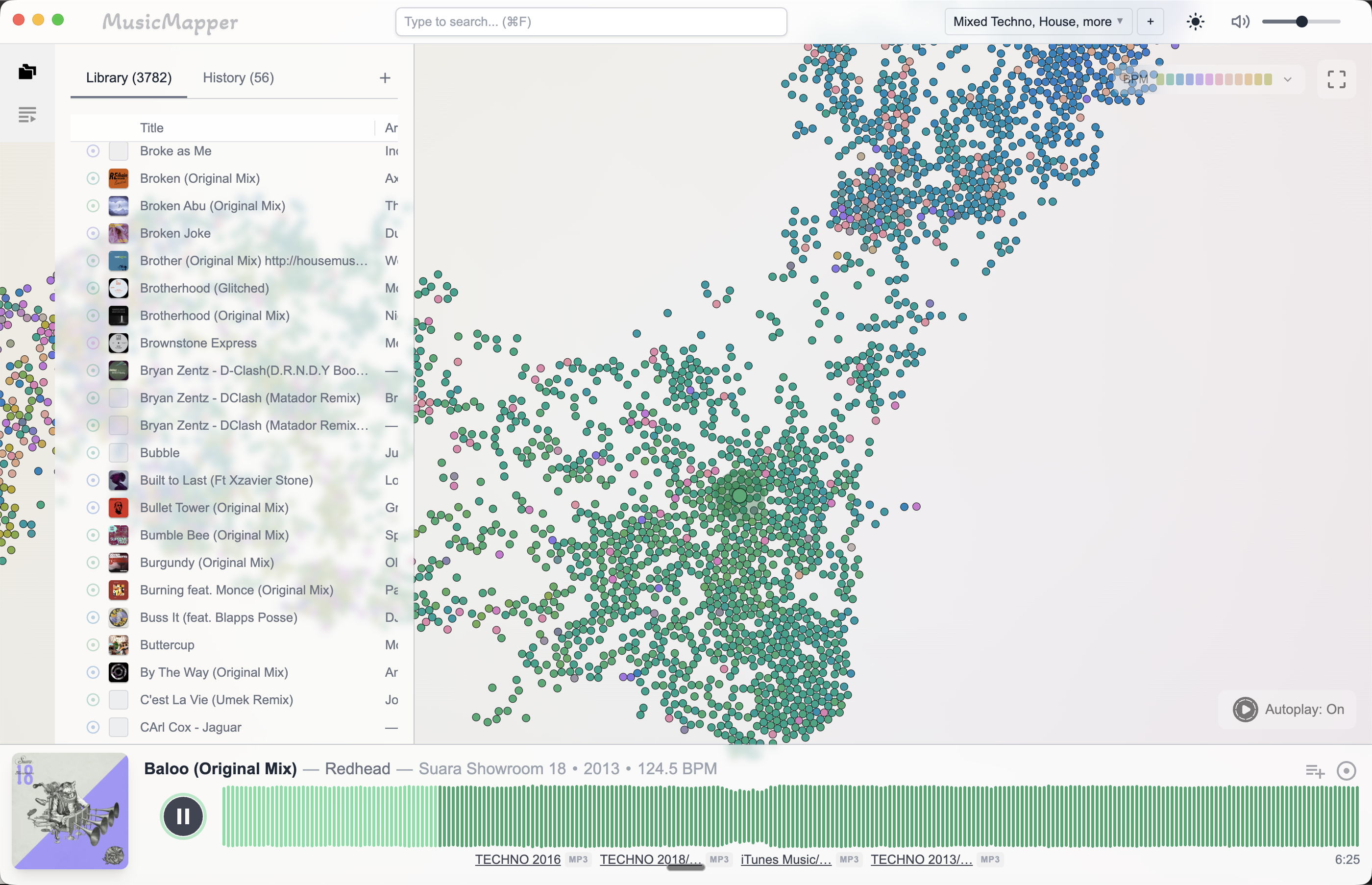
If your library is large enough that finding candidates around each anchor takes real time, that's where MusicMapper earns its place. You drop in an anchor track, it maps your full local collection by sonic similarity, and surfaces what sits nearby — across the whole library, not just the folders you remember to check. For a three-anchor prep session, that speeds up the discovery step substantially.
What it does not do is tell you which direction the room will go. It does not sequence the shortlist into a set, and it does not replace the listening and judgement that turns candidates into something you trust. That part is still yours.
If you know your library well enough to build the candidate pool by memory, you probably do not need the tool for this. The anchor-based approach works with or without it. The tool matters when the library is large enough that memory is not enough and scrolling is too slow.
Final takeaway
A blank brief is not a reason to pack everything. It is a reason to think more carefully about what directions the night might go and to build a shortlist that covers each one.
Work from multiple anchors. Build a pool of candidates for each likely set phase. Go in with enough range to adapt — and know which part of your shortlist belongs to each moment, so the adaptation is a choice, not a scramble.
For the broader mechanics of building a shortlist, read How to build a DJ shortlist before a gig. For why a large library creates problems when you need to find the right track fast, read A large DJ library will slow you down — unless you work with it differently. For the full set prep workflow from a local collection, read How to prepare a DJ set from your local collection.
Explore MusicMapper
See how the workflow looks on your own music library.
MusicMapper helps you explore a local collection as a visual map, preview similar tracks quickly, and build playlists for sharper set preparation.
Frequently asked questions
How many tracks should I prepare when I don't know the crowd?
Roughly two to three times what you plan to play, but organised around different energy moments rather than just volume. For a two-hour set, aim for sixty to eighty candidates that cover a range of moods and intensities — not five hundred tracks pulled at random.
How do I find tracks for a set when I have no brief?
Work from multiple anchor tracks, not one. Pick one anchor for a gentle opening, one for a mid-set build, one for a potential peak. Each anchor pulls its own cluster of related candidates from your library. The union of those clusters gives you a shortlist with real range.
Keep Reading
Related articles
Guide
How to Build a DJ Shortlist Before a Gig
A shortlist is the step most DJs skip — going straight from a library of thousands down to a final set in one pass. That's why set prep is slow and why you end up defaulting to familiar weapons. The shortlist is not a nice-to-have. It's the mechanism that makes good track selection possible.
Guide
A Large DJ Library Will Slow You Down — Unless You Work With It Differently
A large DJ library works against you when you navigate it with folders, search, and memory — tools that were designed for smaller collections. The same library becomes an advantage when you work from a visual map, where more tracks means more candidates the similarity engine can surface around your reference track.
Guide
How to Prepare a DJ Set From Your Local Collection
The easiest way to prepare a stronger DJ set from your local collection is to split the work into two stages. First, discover and shortlist. Then organize and finalize. Most DJs create friction when they try to do both jobs at the same time.