It's the afternoon before the gig. You have a few hours. You open your library, find something you trust, drop it into a new playlist, and then spend the next ninety minutes scrolling — picking one track, second-guessing it, putting another one in, pulling the first one out. You end up with a playlist of twenty-two tracks, eleven of which are your usual weapons, and you're not sure any of it hangs together as a set.
You skipped a step. Most DJs do.
The step most DJs skip
Between a full library and a final set, there is a middle stage: the shortlist.
Not a running order. Not a locked playlist. Just a pool — a rough collection of tracks that belong somewhere in this set, for this gig, for this room. You haven't decided where yet. You haven't committed to any order. You're just pulling candidates.
That distinction matters more than it sounds.
When you go directly from a library of five or ten thousand tracks to a final playlist, every decision carries full weight. You're not just asking "does this track fit the set?" — you're asking "does it fit here, at this position, after that track, before the next one?" Those are three different questions, and trying to answer all of them at once is what makes prep slow and what pushes you toward the safe, familiar choices.
The shortlist separates those decisions. First pass: does this track belong anywhere in this set? Second pass: where exactly does it go?
Why the pool needs to be bigger than the set
A shortlist works best when it contains roughly two to three times as many tracks as you plan to actually play.
For a two-hour set of around thirty tracks, that means sixty to ninety candidates. That sounds like a lot. It is not. You need enough room to make real choices when you cut down, which means you need enough candidates that some of them lose.
If your shortlist has thirty-five tracks and you need thirty for the set, you're barely making any decisions at all. Every track almost certainly ends up in. There's no quality filter operating.
If your shortlist has seventy tracks and you need thirty, you're discarding half of them. The half that stays has actually competed for the spots. The set improves because the shortlist was large enough to be useful.
Building a bigger pool than you need also gives you options when the room doesn't go where you expected. Three or four tracks that would have worked for a peak moment are better than one. If the crowd isn't there yet, you can use a different one. That flexibility is a direct product of not having committed too early.
How to actually build one
Start with a single anchor — one track you know belongs in the set. Not a genre, not a folder, not a BPM range. One specific track that you trust for this gig.
From that anchor, ask: what else belongs near this? Not what else belongs in the set — just near this anchor. Similar energy, similar feel, a track that could logically follow or precede it without jarring the listener.
Add a few. Then pick one of those and ask the same question from a new starting point. You are not trying to sequence anything yet. You are just exploring outward from known points and collecting what seems right.
This approach tends to surface tracks you wouldn't have found by scrolling. It also tends to be faster, because you're evaluating a small cluster of candidates at any one time rather than scanning a library of thousands.
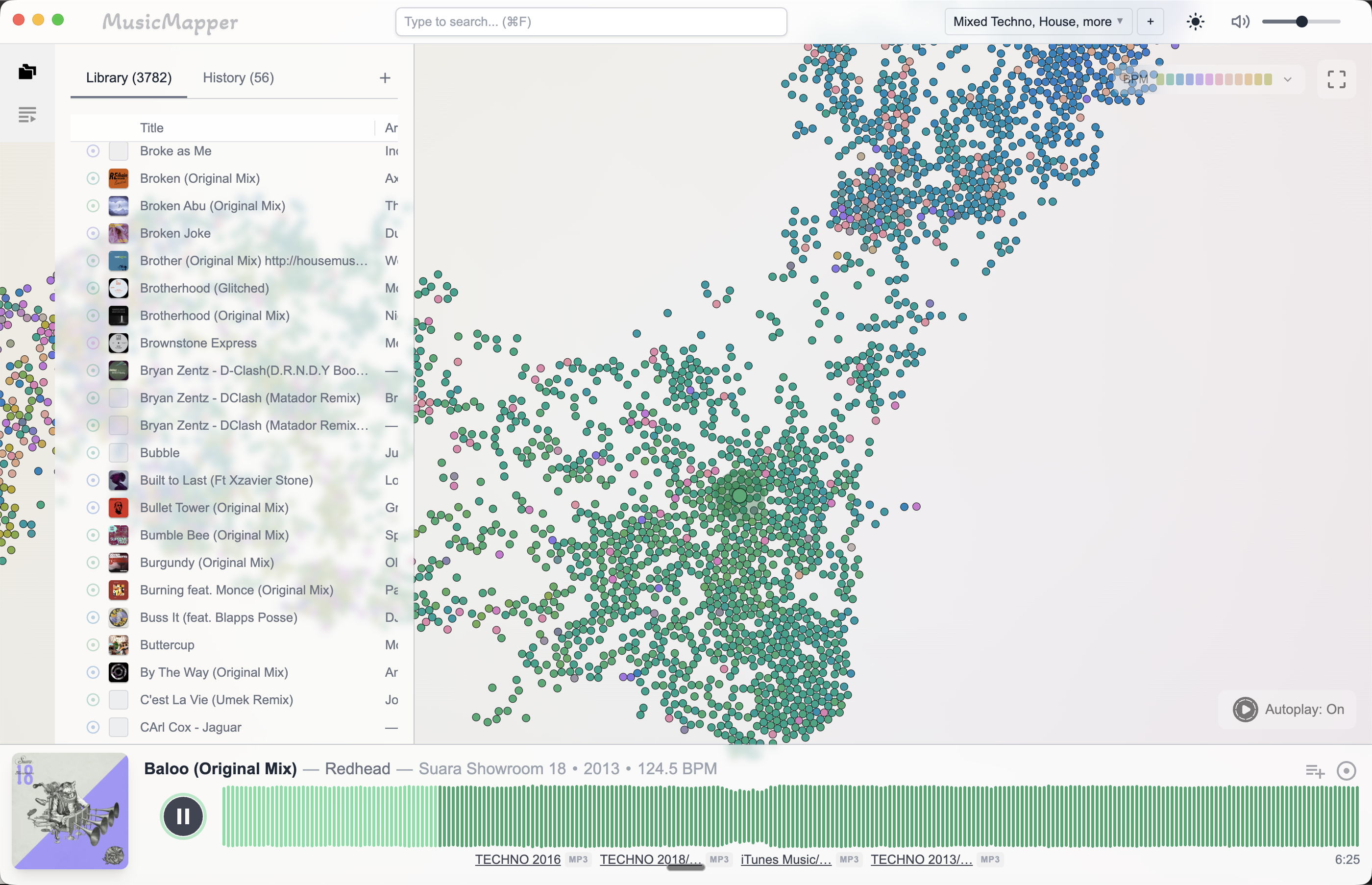
Do this from several different anchor points — one for the opening, one for a peak moment, one for later in the set when things tend to drop in energy. Each anchor pulls in its own neighbourhood of related candidates. The union of those neighbourhoods becomes your shortlist.
What a usable shortlist looks like
A shortlist is not a playlist yet. It does not need to be in any order. It does not need to be organised by BPM or key or energy level — those decisions come later.
What it needs is to feel coherent in spirit. Every track on it should have passed a simple test: you heard it or thought of it in the context of this set and said yes, this belongs here somewhere. Not "this is technically compatible." Not "this is in the right genre." Just: this fits.
If you are looking at your shortlist and half the tracks feel like compromises — they're in there because you couldn't find anything better, or because they're familiar — that's a sign the pool is too narrow. Go back and explore from a different anchor. The shortlist should feel like abundance, not scarcity.
Where MusicMapper fits — and where it doesn't
MusicMapper is useful specifically at the shortlist-building stage. You drop in an anchor track from your local library, and it surfaces what sits nearby by feel and sonic similarity. That's the outward-exploration step described above, done faster and with more coverage.
It is not a sequencing tool. It does not help you order the shortlist into a set. It does not sync with your deck software or export a running order. The shortlist it helps you build still needs to go into Rekordbox or Serato for the actual arrangement and export step.
If you already have a strong instinct for your library — if you know it well enough that exploration is not the bottleneck — you probably do not need this kind of tool. The shortlist step still matters, but you can build the pool manually without losing much.
The tool earns its place when the library is large enough that you genuinely cannot hold it in working memory. At that scale, anchor-based exploration beats scrolling.
Final takeaway
The shortlist is not an optional extra step. It's the mechanism that makes set prep faster and track selection sharper.
Build a pool that's bigger than the set. Use anchor tracks to explore outward rather than scanning from scratch. Keep the stakes low until you're cutting the shortlist down — not before.
The final set is easier to build when the shortlist gives you real options to choose from.
For the broader mechanics of working with a large library, read Why a bigger DJ library makes set prep harder. For finding what belongs near an anchor track, read How to find matching tracks in a large local DJ library. For turning the shortlist into a full prep session, read How to prepare a DJ set from your local collection.
Explore MusicMapper
See how the workflow looks on your own music library.
MusicMapper helps you explore a local collection as a visual map, preview similar tracks quickly, and build playlists for sharper set preparation.
Frequently asked questions
How many tracks should be on a DJ shortlist?
Roughly two to three times the number of tracks you plan to actually play. For a two-hour set of thirty tracks, aim for sixty to ninety candidates on your shortlist. Enough to have real options; not so many that you've recreated the original problem.
What's the difference between a shortlist and a setlist?
A setlist is your final running order — committed, sequenced, ready to play. A shortlist is a loose pool of candidates you haven't committed to yet. The shortlist is built first, under low stakes. The setlist is cut from it, under much lower pressure than cutting from the full library.
Keep Reading
Related articles
Guide
A Large DJ Library Will Slow You Down — Unless You Work With It Differently
A large DJ library works against you when you navigate it with folders, search, and memory — tools that were designed for smaller collections. The same library becomes an advantage when you work from a visual map, where more tracks means more candidates the similarity engine can surface around your reference track.
Guide
How to Prepare a DJ Set From Your Local Collection
The easiest way to prepare a stronger DJ set from your local collection is to split the work into two stages. First, discover and shortlist. Then organize and finalize. Most DJs create friction when they try to do both jobs at the same time.
Guide
How to Find Matching Tracks in a Large Local DJ Library
When a DJ library gets large, the problem is rarely a lack of good music. The real problem is surfacing the right tracks fast enough. The easiest fix is to stop treating discovery as a folder problem and start treating it as a listening and relationship problem.